
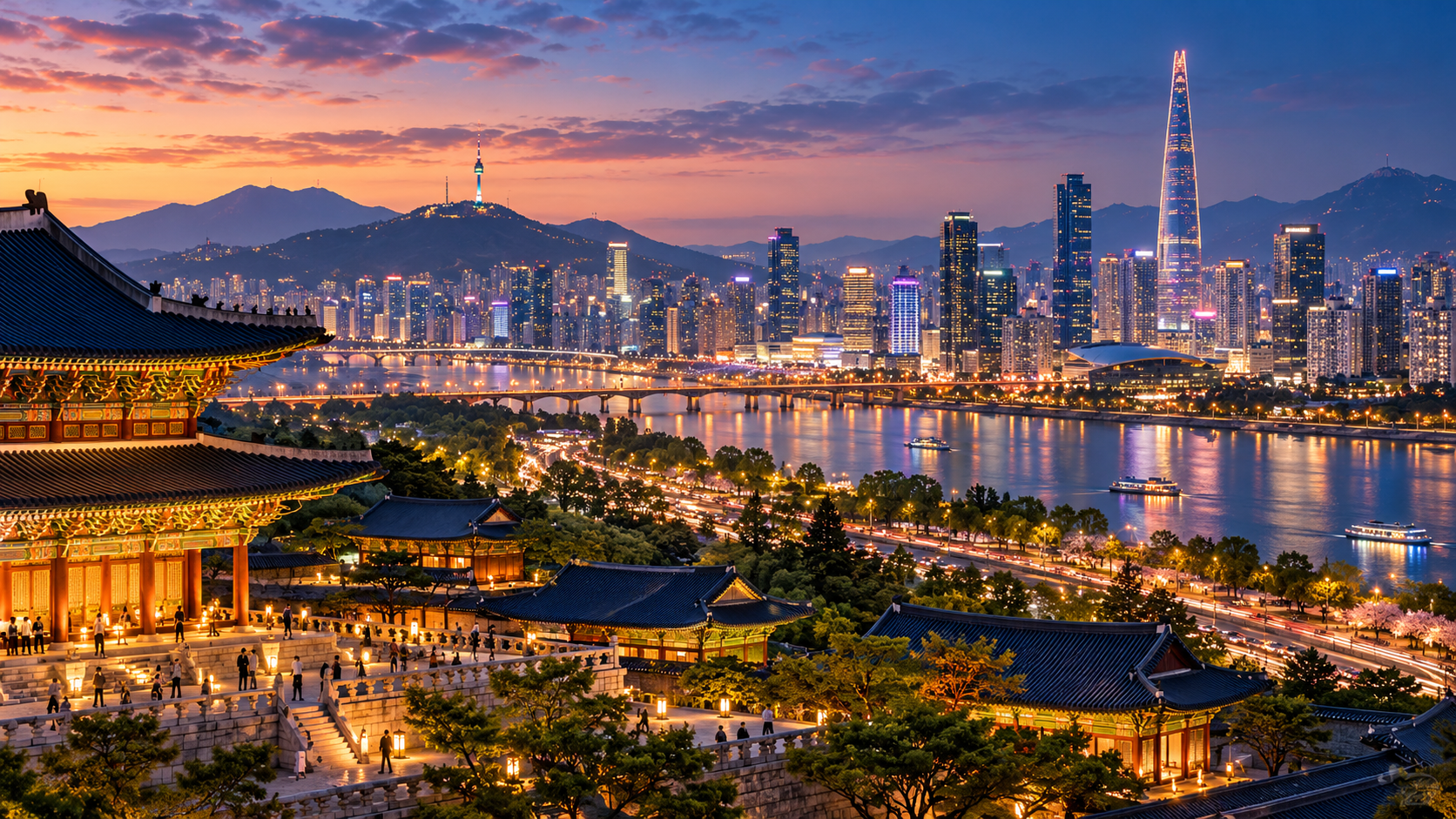
Ask “what is Seoul?” and the short answer sounds almost too simple.
Seoul is the capital of South Korea.
But that tells you almost nothing about what the city actually feels like.
Seoul is a place where a royal palace from the Joseon Dynasty can sit a few subway stops from a neighborhood filled with giant digital screens, cosmetic stores and cafés selling desserts that look like small works of architecture.
You can spend the morning walking beside traditional wooden houses, eat lunch in a market where somebody has been making the same noodle dish for decades, then end the night in a district where restaurants and shops stay busy long after many American downtowns have gone quiet.
That contrast is the whole point.
Seoul is old and new at the same time. It is organized and chaotic. Huge but surprisingly easy to move around. Fast-paced, yet full of mountain trails, palace gardens and riverside parks where people slow down.
And yes, the city really is enormous.
So where exactly is Seoul?
Seoul sits in the northwestern part of South Korea along the Han River.
The city itself has roughly 9.6 million residents, while the broader metropolitan area extends far beyond the official city boundary.
For an American comparison, think less “one downtown with surrounding suburbs” and more “a collection of major urban districts stitched together by an extremely efficient transit system.”
Each district has its own personality.
Gangnam feels different from Jongno. Hongdae does not feel like Itaewon. Seongsu has a different energy from Myeongdong.
And that is why you should not plan Seoul around one central square.
| Area | What It Feels Like | Why Go |
|---|---|---|
| Jongno | Historic, cultural, traditional | Palaces, Bukchon, temples and old Seoul |
| Myeongdong | Busy, commercial, tourist-friendly | Shopping, street food and cosmetics |
| Hongdae | Young, creative, energetic | Music, cafés, nightlife and shopping |
| Gangnam | Modern, polished, business-heavy | Shopping, restaurants and contemporary Seoul |
| Seongsu | Industrial-chic, trendy, café-focused | Design, pop-ups, fashion and coffee |
| Itaewon | International, nightlife-oriented | Global food, bars and mixed communities |
The city becomes much easier once you stop thinking of Seoul as one neighborhood with famous attractions.
It is a city of districts.
The Han River divides more than the map
The Han River runs through Seoul and separates large parts of the city into areas north and south of the water.
Historically, many of Seoul’s older political and cultural districts developed north of the river.
South of it, districts such as Gangnam became symbols of modern development, business, wealth and urban expansion.
The river is not just geographic infrastructure, though.
It is also where people go to relax.
Riverside parks attract cyclists, runners, families and groups of friends. People sit beside the water with convenience-store food, takeout chicken or picnic supplies and stay into the evening.
One of the easiest ways to understand everyday Seoul is to spend an hour doing absolutely nothing beside the Han River.
No palace ticket required.
Seoul’s palaces are not decorative tourist props
Before skyscrapers and subway lines, Seoul was the capital of the Joseon Dynasty.
That history still shapes the city.
Several major royal palaces remain, including Gyeongbokgung, Changdeokgung, Changgyeonggung, Deoksugung and Gyeonghuigung.
Gyeongbokgung is the one most first-time visitors recognize.
It is broad, formal and visually dramatic, with mountain scenery rising behind palace roofs.
Changdeokgung feels different.
The palace was designed to fit more naturally into its landscape, and its famous rear garden follows the terrain rather than forcing everything into rigid symmetry.
UNESCO recognizes Changdeokgung as a World Heritage property.
And here is the useful part: the palaces are not isolated from modern Seoul.
You can literally step out of a royal complex and find yourself back among cafés, traffic and office buildings.
Bukchon looks like old Seoul, but people actually live there
Bukchon Hanok Village is often presented online as a perfect collection of traditional Korean houses.
That description is not wrong.
It is incomplete.
The neighborhood contains hanok, traditional Korean houses, sitting on hilly streets between major historic areas.
But Bukchon is also residential.
People live behind those doors.
This matters because visitors sometimes treat the streets like an outdoor movie set.
Keep your voice down. Respect signs. Do not block private entrances for photos.
You can enjoy the architecture without behaving as if every doorway belongs to your Instagram account.
Seoul is one of the easiest giant cities to navigate
This may be the biggest surprise for first-time visitors.
The city looks intimidating on a map.
Then you use the subway.
Seoul’s rail network is extensive, stations are clearly numbered and color-coded, and major signs commonly include English.
For tourists, this makes a huge difference.
You do not need to understand Korean to move around confidently.
A T-money transportation card works across subways and buses and can also be used in some other everyday situations.
Subway services generally begin early in the morning and continue until around midnight, though exact operating times vary by station and line.
And yes, transfers can involve walking.
Some stations are basically underground neighborhoods.
The subway changes how you experience the city
In many American cities, distance changes your itinerary.
In Seoul, a neighborhood that looks far away may simply mean another efficient train ride.
That makes it tempting to cross the city five times in one day.
Don’t.
The subway is efficient. Your legs are still human.
- Group nearby neighborhoods into the same day.
- Use T-money rather than buying individual tickets repeatedly.
- Pay attention to station exit numbers because the wrong exit can put you several blocks away.
- Allow extra walking time inside major transfer stations.
- Keep the last train in mind if you stay out late.
That exit-number tip sounds tiny until you ignore it.
Then suddenly you’re on the wrong side of an eight-lane road.
Korean food is much more than barbecue
American diners often meet Korean food through barbecue.
Grilled meat at the table. Lettuce wraps. Side dishes. Soju.
Great start.
But Seoul makes it obvious how much more there is.
Korean meals often include banchan – small side dishes served alongside the main food. Kimchi is the famous one, but there may also be seasoned vegetables, pickles, tofu, fish cakes or other small dishes.
Soups and stews matter enormously.
Noodles matter.
Rice cakes matter.
Fried chicken definitely matters.
And convenience-store food is its own category of urban life.
What should you eat on a first trip?
You do not need a 40-item food checklist.
Start with the classics and let curiosity do the rest.
- Try Korean barbecue with pork belly or beef.
- Order bibimbap when you want something easy to understand but full of flavor.
- Try tteokbokki if chewy rice cakes in a spicy sauce sound good.
- Eat Korean fried chicken at least once.
- Try a stew such as kimchi jjigae or sundubu jjigae.
- Have gimbap for a quick meal or snack.
- Stop at a traditional market and eat something you did not plan.
That final suggestion is probably the most useful.
Markets are where food stops being a travel checklist and starts feeling normal.
Gwangjang Market is famous for a reason
Gwangjang Market has become one of Seoul’s best-known food markets.
It is crowded, busy and definitely not a secret.
Still, the energy is worth experiencing.
You can find dishes such as mung bean pancakes, noodles, gimbap and various snacks served at counters where people eat shoulder to shoulder.
It can feel chaotic if you’re used to quiet restaurants.
That’s fine.
Pointing, smiling and watching what other people order solves a surprising number of problems.
Kimchi is not one thing
People outside Korea often talk about kimchi as if there is one standard recipe.
There are many varieties.
Napa cabbage kimchi is the most internationally familiar, but radish, cucumber and other vegetables can also be fermented or seasoned in kimchi-style preparations.
Flavor changes with region, season and household.
So if the first kimchi you try seems too sour, too spicy or too strong, try another.
You are not rejecting an entire food category after one bite.
Café culture in Seoul is borderline competitive
Seoul has a lot of cafés.
Then it has cafés inside neighborhoods already full of cafés.
Then one of those buildings contains three more cafés on separate floors.
The city takes coffee and dessert spaces seriously.
Some are minimalist. Others look like greenhouses, libraries, industrial warehouses or art installations.
Seongsu is especially well known for this modern café-and-design culture.
Former industrial spaces have been turned into coffee shops, fashion stores and pop-up venues.
The fun is not only drinking coffee.
It is seeing how much effort can apparently be invested in a room where people mostly sit and stare at phones.
Myeongdong is intense, but useful for a first visit
Myeongdong is commercial Seoul turned up loud.
Stores, skincare, cosmetics, street snacks, bright signs and crowds fill the district.
If you love shopping, you’ll probably enjoy it.
If you hate shopping, an hour may be enough.
Korean beauty products are a major draw, but do not assume every product needs to come home with you because a salesperson said it is “number one in Korea.”
Your suitcase has limits.
Your bathroom shelf probably does too.
Hongdae stays young even when you don’t
Hongdae developed around Hongik University and became associated with youth culture, indie music, fashion and nightlife.
Today it is highly commercial as well, but the area still has a younger energy than many central business districts.
You may find street performances, themed cafés, small music venues, shopping streets and bars packed into a relatively compact area.
Go in the evening if you want to understand why people like it.
At 10 a.m., Hongdae can feel like a party venue someone forgot to turn on.
Gangnam is not just a song
For many Americans, “Gangnam” became globally recognizable through music.
The district itself is a huge business, shopping and residential area south of the Han River.
Wide roads, office towers, luxury stores, clinics, restaurants and apartment complexes define much of the landscape.
It feels noticeably different from the palace districts north of the river.
This is useful because Seoul’s story is partly about rapid urban development.
Gangnam shows that story in physical form.
Seongsu is where Seoul gets trendy very quickly
Seongsu has become strongly associated with design, fashion, cafés and pop-up stores.
Brands open temporary spaces. Warehouses become stylish retail concepts. Coffee shops appear in buildings that still carry industrial bones.
The neighborhood can feel like Brooklyn comparisons are waiting to happen.
Resist them.
Seongsu developed within Seoul’s own industrial and commercial history, and reducing every creative neighborhood to “the Brooklyn of somewhere” gets old fast.
Just enjoy it for what it is.
The mountains are closer than you expect
One of Seoul’s best features is how quickly dense urban neighborhoods give way to hiking trails.
Mountains surround parts of the city, and hiking is a major recreational habit.
Bukhansan National Park is one of the best-known outdoor areas near central Seoul.
You can reach trail access by public transportation, hike above the city and be back at a restaurant that evening.
That city-to-mountain transition feels almost unfairly convenient.
And hiking culture is visible.
Proper gear is common. People take it seriously.
You may show up wearing basic sneakers and realize everyone around you appears prepared to summit Everest before lunch.
Namsan gives you the easier city view
If you do not want a full hike, Namsan is much easier.
The hill rises close to central Seoul and offers city views from around N Seoul Tower and surrounding paths.
You can walk up, use public transportation options nearby or combine several routes depending on your energy level.
The view helps explain Seoul’s scale.
Buildings keep going.
And going.
And then mountains interrupt them.
Nightlife does not end early
Seoul runs late.
Restaurants stay busy. Convenience stores remain useful. Some cafés operate late. Bars and entertainment districts can continue deep into the night.
This does not mean every neighborhood is active 24/7.
But compared with many U.S. cities, late-night options are abundant.
Korean drinking culture can also involve multiple rounds.
Dinner may become drinks. Drinks may become karaoke. Karaoke may somehow become more food.
If someone says, “one more place,” understand that this phrase has flexible mathematical meaning.
Noraebang is more fun than it sounds on paper
Noraebang means a singing room.
Think karaoke, but instead of performing in front of a bar full of strangers, you rent a private room with friends.
That changes everything.
People who would never sing publicly suddenly become emotionally committed to a power ballad at 1 a.m.
It is one of the easiest Korean nightlife experiences for foreign visitors because you do not need much cultural knowledge to understand the basic idea.
Pick a song.
Sing badly.
Continue confidently.
Seoul shopping goes far beyond luxury malls
There are department stores and designer districts, yes.
But shopping in Seoul also means underground malls, traditional markets, stationery stores, beauty shops, fashion streets and convenience stores with limited-edition snacks you did not know you needed.
Different neighborhoods specialize in different moods.
| Shopping Area | Good For | General Feel |
|---|---|---|
| Myeongdong | Beauty, mainstream fashion | Busy and tourist-friendly |
| Hongdae | Youth fashion, accessories | Casual and energetic |
| Gangnam | Department stores, luxury | Modern and polished |
| Insadong | Traditional gifts, crafts | Cultural and slower |
| Seongsu | Designer brands, pop-ups | Trendy and experimental |
One warning: Seoul makes impulse shopping very easy.
Budget accordingly.
Convenience stores are weirdly important
This sounds like a joke until you visit.
Convenience stores are part of everyday urban life in Seoul.
You can buy drinks, snacks, instant noodles, simple meals and basic necessities at almost any hour.
Some locations have seating areas where people actually eat what they just bought.
The experience is humble, cheap and surprisingly useful.
Not every meal needs to become a restaurant research project.
Seoul’s seasons are very real
This is not a year-round mild climate.
Summer can be hot and humid. Winter can be cold and dry.
Spring and fall are popular for good reason.
Cherry blossoms appear in spring, though exact timing changes every year with weather.
Fall brings cooler temperatures and foliage around parks, palaces and mountains.
Summer includes a rainy monsoon period and high humidity.
Winter temperatures can fall well below freezing.
Pack according to the actual season, not according to K-drama wardrobe expectations.
When is the best time to visit?
April, May, September and October are often the easiest months for sightseeing.
Spring offers flowers and milder temperatures.
Fall brings clear air, cooler weather and colorful foliage.
Summer works if you do not mind humidity and rain.
Winter can be beautiful when skies are clear, and snow occasionally makes palace architecture especially photogenic.
But it is cold.
Proper-coat cold.
What should you know about Korean etiquette?
You do not need to memorize a rulebook before landing.
Pay attention, be polite and follow the room.
Still, a few habits help:
- Keep voices relatively low on public transportation.
- Give priority seats to people who need them.
- Remove shoes when entering homes and some traditional spaces.
- Use both hands when giving or receiving something in more formal situations.
- Do not stick chopsticks upright into a bowl of rice.
- Respect queues and personal space even when stations get crowded.
Tourists make small mistakes.
Nobody expects you to arrive with perfect Korean social instincts.
Do you need to speak Korean?
No, especially for a short tourist visit.
Major subway signs include English. Tourist districts often have English-language menus or translations. Translation apps help with the gaps.
Still, learning a few basic Korean phrases changes interactions.
A simple hello or thank you goes a long way.
And do not assume every person under 30 speaks fluent English.
Some do. Some don’t.
Your phone can handle the rest.
How many days do you need in Seoul?
Four days gives you a solid introduction.
Five to seven is much better if you want neighborhoods rather than only landmarks.
Seoul is too large for the “48 hours and we’ve seen it” approach.
A comfortable first trip might look like this:
- Day one: Gyeongbokgung, Bukchon and Insadong.
- Day two: Myeongdong, Namsan and central Seoul.
- Day three: Hongdae and nearby western neighborhoods.
- Day four: Gangnam or Seongsu.
- Day five: Bukhansan, Han River or a slower food-focused day.
And leave room for wandering.
Your favorite place may be a neighborhood café you never intended to visit.
What Americans often get wrong about Seoul
The first mistake is assuming Seoul is basically Tokyo with Korean food.
It isn’t.
The urban history, architecture, social rhythm and language are different.
The second mistake is thinking the city is only futuristic.
Yes, Seoul has advanced infrastructure and highly digital everyday life. It also has royal shrines, mountain fortifications, traditional markets and neighborhoods built around older street patterns.
The third mistake is assuming everyone is obsessed with K-pop.
K-pop is globally important and visible.
It is still one part of a much larger cultural landscape.
And the fourth mistake?
Planning every hour.
Seoul rewards curiosity more than checklists.
FAQ About Seoul
What is Seoul?
Seoul is the capital and largest city of South Korea. It is the country’s main center for government, business, media, culture, education and entertainment.
How many people live in Seoul?
As of early 2026, the city itself had about 9.58 million residents. The wider Seoul metropolitan region is much larger.
What is Seoul famous for?
Seoul is known for royal palaces, Korean food, shopping, technology, K-pop, nightlife, mountains, traditional neighborhoods and a highly developed subway system.
Is Seoul easy to get around?
Yes. The subway and bus networks are extensive, signs commonly include English, and a T-money transportation card makes public transit straightforward for visitors.
How many days do you need in Seoul?
Four days gives you a good introduction. Five to seven days is better if you want time for several neighborhoods, markets, palaces and outdoor areas without rushing.
What is the best time to visit Seoul?
Spring and fall are especially popular because temperatures are generally comfortable. April, May, September and October are strong choices for many first-time visitors.
Is Seoul expensive?
It can be, but budget travel is very possible. Public transportation is affordable, casual Korean food can be inexpensive, and convenience stores provide cheap snacks and simple meals. Hotels and trendy districts can raise the budget quickly.
Seoul Makes Sense Once You Stop Looking for One Version of It
So, what is Seoul?
It is not one thing.
It is a royal palace beside an office tower.
A mountain trail reached by subway.
A crowded market where someone serves noodles in thirty seconds.
A café that took six months to design so people could spend forty minutes drinking an iced latte.
A group of friends sitting beside the Han River with fried chicken.
A quiet shrine in the middle of a city of millions.
And a subway station so large that you may briefly question whether you still live above ground.
That mix is why Seoul sticks with people.
You can come for Korean food and end up fascinated by architecture.
You can come for K-pop and discover hiking.
You can arrive expecting pure futurism and spend your favorite afternoon walking between wooden palace buildings.
The city constantly changes scale and mood.
One moment feels enormous. The next feels strangely intimate.
For a first trip, don’t worry about seeing every famous neighborhood.
See a palace.
Eat in a market.
Ride the subway.
Spend one night in Hongdae or another lively district.
Go to the river.
Climb somewhere high enough to understand just how big the city really is.
Then leave one afternoon open.
Seoul tends to fill it for you.
Leave a Reply