
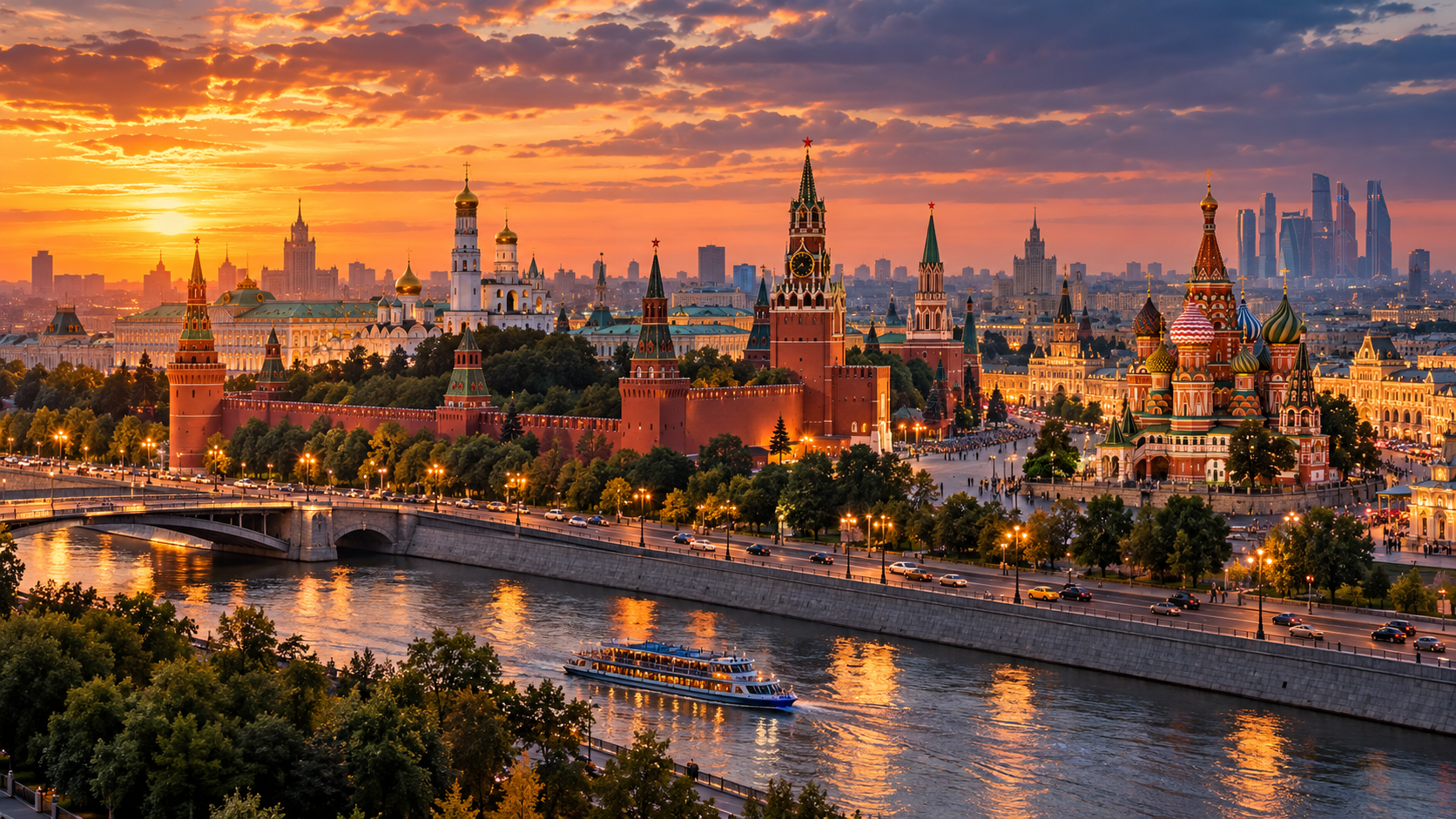
For many Americans, Moscow arrives in the imagination before the actual city does.
You picture St. Basil’s Cathedral. Red Square. Snow. Ornate metro stations. Maybe onion domes glowing against a dark winter sky.
All of that exists.
But Moscow is far larger, greener and more varied than the postcard version suggests.
This is a city of broad avenues, apartment districts, old churches, ambitious architecture, riverside parks, huge museums, neighborhood cafés and one of the most recognizable subway systems anywhere.
It can feel monumental in one block and surprisingly quiet in the next.
You can spend the morning inside a medieval cathedral, ride a metro station that looks like a marble ballroom, eat lunch at a casual café and end the afternoon walking through a park that feels far removed from the city center.
That contrast is what makes Moscow interesting.
If you’re researching moscow russia, it helps to forget the idea that the city is one giant historical monument.
It is a living megacity built in layers.
Where exactly is Moscow?
Moscow sits in western Russia along the Moskva River.
It is the country’s largest city and one of Europe’s biggest urban areas.
The center follows a roughly circular structure, with major ring roads and historic districts radiating outward from the Kremlin.
That layout matters.
Many visitors arrive thinking in terms of individual attractions: Red Square, the Kremlin, one museum, one cathedral.
But Moscow makes more sense when you think by neighborhoods and rings.
The historic center is dense and walkable in parts, while the wider city stretches far beyond what most tourists see.
| Area | Best Known For | Why Go |
|---|---|---|
| Red Square | St. Basil’s Cathedral, historic center | Classic first view of Moscow |
| Kremlin | Cathedrals, walls, historic architecture | One of the city’s most important historic complexes |
| Zamoskvorechye | Older streets, churches, Tretyakov Gallery | Slower atmosphere close to the center |
| Arbat | Pedestrian streets and older city fabric | Easy walking and central access |
| Gorky Park area | Riverfront, green space, contemporary culture | Modern leisure and long walks |
| VDNKh | Monumental Soviet-era architecture | Huge-scale urban design and exhibitions |
The city is too large to conquer by simply walking from one landmark to another.
Luckily, the metro changes everything.
Red Square is the obvious place to begin
Some famous places feel smaller in person.
Red Square does not.
The space opens between the Kremlin walls, St. Basil’s Cathedral, the State Historical Museum and the long facade of GUM.
It feels theatrical because, frankly, it is.
Centuries of state ceremony, trade, religion and public life have passed through this part of Moscow.
The name does not originally come from the color red in the modern political sense. The old Russian word associated with the square could also carry the meaning of “beautiful.”
Today the square works as both a major historic space and one of the most photographed places in the country.
Go early if you want to feel the scale without immediately being surrounded by tour groups.
St. Basil’s Cathedral looks almost unreal
St. Basil’s is the building that most strongly says “Moscow” to people who have never been there.
The colorful domes make it look almost playful from outside.
The interior is a different experience.
Instead of one huge open hall, the cathedral is made up of smaller chapels, corridors and decorated spaces that feel more intimate than the exterior suggests.
The building dates to the 16th century and was commissioned during the reign of Ivan IV.
From outside, it is instantly recognizable.
Inside, it feels like a maze.
That contrast makes it more interesting than simply taking a photo from the square and leaving.
The Kremlin is not one building
This is another thing first-time visitors sometimes misunderstand.
The Moscow Kremlin is a large fortified complex.
Inside are cathedrals, palaces, towers, squares and historic buildings developed over centuries.
UNESCO recognizes the Kremlin and Red Square together as a World Heritage property.
The Kremlin has been closely connected with Moscow’s political and religious history since the medieval period.
For travelers, Cathedral Square is one of the highlights.
Several major Orthodox cathedrals stand close together, creating a concentrated view of Moscow’s older religious architecture.
Give the complex time.
This is not a twenty-minute attraction.
GUM is basically a palace that happens to contain stores
Facing the Kremlin across Red Square, GUM looks far grander than the phrase “shopping mall” suggests.
The historic building stretches along the eastern side of the square with elaborate interiors, high glass ceilings and long galleries.
Even if you are not shopping, walk inside.
The architecture is part of the experience.
And it gives you a warm indoor break if Moscow weather is being particularly Moscow.
The metro might be the attraction you use every day
Moscow’s metro has become famous partly because some stations look nothing like ordinary transit stops.
Marble columns. Chandeliers. Mosaics. Sculptures. Decorative ceilings.
Some stations were designed to communicate grandeur as much as practicality.
The strange part is that commuters still use them like normal infrastructure.
You may be standing under an elaborate mosaic trying to frame a photo while somebody next to you is simply annoyed that their train is thirty seconds away.
That tension is very Moscow.
Which metro stations are worth seeing?
You do not need to turn the subway into an all-day museum tour.
Pick a few memorable stations and combine them with actual transportation.
- Komsomolskaya is known for its grand hall and decorative ceiling.
- Mayakovskaya stands out for elegant Art Deco-inspired design.
- Ploshchad Revolyutsii is famous for bronze sculptures lining the station.
- Novoslobodskaya is known for stained-glass panels.
- Kievskaya features decorative mosaics and ornate details.
The best way to see the metro is naturally.
Ride somewhere useful, get off, look around, continue.
Much better than spending four hours underground collecting stations like Pokémon.
The Tretyakov Gallery explains Russian art better than a textbook does
If Russian art means nothing more to you than vague memories of icons and 19th-century portraits, the Tretyakov Gallery helps organize the picture.
The historic gallery in Lavrushinsky Lane focuses on Russian art from medieval icons through major painters of the 18th, 19th and early 20th centuries.
The collection includes religious art, portraiture, landscapes and large-scale historical paintings.
It is the kind of museum where names that felt abstract in a history book suddenly become connected.
The building itself also has character, especially its distinctive facade.
Do not schedule it after five hours of walking.
Museum fatigue is undefeated.
New Tretyakov shows another Moscow entirely
The New Tretyakov Gallery on Krymsky Val moves into the 20th century and contemporary period.
This means modernism, avant-garde movements, Soviet-era art and later developments.
If the historic Tretyakov gives you icons and classical painting, the New Tretyakov gives you abstraction, experimentation and a much more modern cultural story.
The contrast between the two branches works well.
You can visit one without the other, but together they show just how wide the phrase “Russian art” really is.
Zamoskvorechye is good when the center feels too grand
Cross the river south of the Kremlin and Moscow changes scale.
Zamoskvorechye has quieter streets, churches, older buildings and a more neighborhood-like atmosphere than the monumental areas around Red Square.
The Tretyakov Gallery sits here, making the district easy to combine with a museum day.
Walk instead of rushing back to the metro.
This is where smaller details start mattering: courtyards, old facades, side streets and cafés that feel less geared toward sightseeing.
Arbat is touristy, but it still works
Old Arbat is one of Moscow’s best-known pedestrian streets.
Yes, there are souvenir shops.
Yes, it can feel commercial.
But the surrounding area still offers older architecture, side streets and easy access to central Moscow.
The mistake is treating one pedestrian street as the entire neighborhood.
Walk beyond it.
The side streets are often more interesting than the main strip.
Moscow’s parks change the city’s personality
One thing visitors often underestimate is how much green space Moscow has.
The city is huge and dense, but large parks break up that scale.
Gorky Park is the obvious example.
It stretches along the Moskva River and functions as a modern public space with walking paths, cycling, seasonal activities, cafés and cultural venues nearby.
This is where Moscow stops feeling ceremonial and starts feeling ordinary.
People run. Families walk. Friends meet. Someone is always carrying coffee.
On a pleasant day, this may tell you more about contemporary city life than another palace interior.
VDNKh is Moscow at maximum scale
VDNKh is difficult to summarize because it is so large.
The vast exhibition complex developed during the Soviet period and contains monumental pavilions, fountains, museums, landscaped spaces and later additions.
The architecture is often dramatic.
Different pavilions were designed to represent republics, industries or achievements, so styles shift as you walk.
You can easily spend half a day here.
Possibly longer if you keep saying, “Let’s just see what is behind that building.”
There is always another building.
Kolomenskoye offers a completely different historical mood
For a quieter historic experience, Kolomenskoye works beautifully.
This large museum-reserve on the Moskva River includes churches, reconstructed wooden architecture, green space and older royal associations.
The Church of the Ascension is especially important for its distinctive 16th-century tent-roof architecture.
The wider park also gives you room to walk without feeling trapped inside a museum schedule.
It is a good break from central Moscow.
Russian food is much more than borscht
Borscht appears on menus, obviously.
But Moscow’s food scene is broader than the small list of dishes many Americans associate with Russia.
You will find Georgian, Armenian, Central Asian and other regional cuisines alongside Russian food.
That mix reflects the city’s scale and long history as a major urban center.
A first-time food list might include:
- pelmeni, small meat-filled dumplings;
- blini served savory or sweet;
- borscht or other soups during colder weather;
- pirozhki, small filled pastries;
- syrniki, cottage-cheese pancakes often eaten for breakfast;
- herring-based salads if you want a very classic experience;
- Georgian khachapuri and khinkali, which are widely popular in Moscow.
That final point matters.
One of the best food choices in Moscow may technically come from another cuisine entirely.
Breakfast can be unexpectedly good
Moscow has developed a strong café and breakfast culture.
You can still find simple traditional breakfasts, but modern cafés may offer eggs, pastries, syrniki, porridge, coffee and all the familiar brunch machinery.
Syrniki are especially worth trying.
They are small pancakes made from tvorog, a fresh curd cheese, and are commonly served with sour cream, jam, berries or condensed milk.
They sound heavy.
They are surprisingly easy to keep eating.
Georgian food is almost impossible to avoid – and that is good
Georgian restaurants are extremely popular in Moscow.
Khachapuri combines bread and cheese in several regional forms. Khinkali are large dumplings filled with meat, broth or other fillings.
The food is rich, social and very easy to like.
If you’re tired after sightseeing and want something satisfying without studying a complicated menu for thirty minutes, Georgian food is a strong move.
Winter Moscow looks incredible but makes you work for it
Snow and Moscow architecture are an excellent combination.
The downside is obvious.
It can be seriously cold.
Winter temperatures regularly fall below freezing, daylight is short and sidewalks may be icy or slushy.
You need proper shoes, warm layers, gloves and a coat designed for winter rather than one that looked stylish in an airport mirror.
The reward?
Snow around Red Square, warm museums, atmospheric cafés and a city that visually fits every winter image people carry in their heads.
Summer feels like another city
Then summer arrives and Moscow changes completely.
Parks fill. Riverfront spaces stay active late. Outdoor cafés appear everywhere. Long daylight makes sightseeing much easier.
June through August is generally the simplest season for walking and outdoor exploration.
Warm days can happen, and occasional heat can surprise travelers expecting permanent cold.
This is also the period when green Moscow becomes most obvious.
The city is much leafier than winter photos suggest.
Spring and fall may be the most balanced seasons
Late spring brings longer days and parks returning to life.
Early fall can offer cool, pleasant walking weather and colorful trees.
The tradeoff is unpredictability.
Moscow weather changes quickly between seasons.
A warm afternoon can become a cold evening.
Layers solve a lot.
| Season | General Feel | Best For |
|---|---|---|
| Spring | Cool to mild, changeable | Museums, parks, fewer summer crowds |
| Summer | Warm, green, long daylight | Walking, parks, riverfront areas |
| Fall | Cool, colorful, increasingly chilly | Photography, walking, cultural trips |
| Winter | Cold, snowy or icy, short days | Classic Moscow atmosphere and museums |
How many days do you need?
Three days is enough to see the headline landmarks.
It is not enough to understand the city.
Four to five days is much better.
That gives you time for Red Square and the Kremlin, one or two major museums, neighborhood walking, parks and the metro without turning the trip into a checklist.
A comfortable first trip might look like this:
- Day one: Red Square, St. Basil’s Cathedral and central Moscow.
- Day two: Kremlin, Cathedral Square and nearby streets.
- Day three: Tretyakov Gallery and Zamoskvorechye.
- Day four: Gorky Park, New Tretyakov and riverfront areas.
- Day five: VDNKh, Kolomenskoye or a slower neighborhood day.
You can add more.
You do not need to.
Moscow is bigger than the map makes it feel
Distances are deceptive.
Two attractions may look close on a city map but still require a substantial walk, metro ride or transfer.
Luckily, public transportation handles the scale well.
Still, group your days geographically.
Do not spend the morning south of the river, lunch far northeast and the afternoon back in the center unless you genuinely enjoy transit logistics.
The metro is efficient.
Your vacation does not need to become a transit challenge.
What should first-time visitors actually prioritize?
Do not try to see every famous building.
Pick a few experiences that show different sides of the city.
- See Red Square early or late in the day.
- Visit the Kremlin as a historical complex, not just a photo stop.
- Ride several classic metro stations naturally during the trip.
- Choose either the historic Tretyakov or New Tretyakov depending on your art interests.
- Spend time in one major park.
- Eat somewhere outside the most obvious tourist zone.
This gives you Moscow the monument and Moscow the city.
You need both.
What Americans often misunderstand about Moscow
The first mistake is assuming it is gray.
Parts of Moscow are monumental, concrete-heavy and enormous, yes.
Others are full of parks, colorful churches, renovated riverfront areas and older streets.
The second mistake is assuming the entire city looks historical.
Moscow is full of contemporary towers, modern malls, new restaurants and large residential districts.
The third mistake is expecting Russian food to dominate every meal.
The restaurant scene includes cuisines from across the Caucasus, Central Asia, Europe and beyond.
And the fourth mistake?
Trying to “do Moscow” in one day.
This is a megacity.
Give it room.
FAQ About Moscow Russia
What is Moscow famous for?
Moscow is best known for Red Square, the Kremlin, St. Basil’s Cathedral, its ornate metro stations, major art museums, monumental architecture and long history as Russia’s largest city.
How many days do you need in Moscow?
Three days covers the headline attractions, while four to five days gives a much better balance of landmarks, museums, parks and neighborhoods.
Is the Moscow Kremlin one building?
No. The Kremlin is a fortified historic complex containing cathedrals, palaces, towers, squares and other buildings within its walls.
Why is Moscow’s metro famous?
Several stations are known for marble, mosaics, sculptures, stained glass and chandeliers, making parts of the subway network feel more like public galleries than ordinary transit spaces.
What food should you try in Moscow?
Try pelmeni, blini, syrniki, soups and Russian pastries. Georgian dishes such as khachapuri and khinkali are also extremely popular across the city.
What is the best season to visit Moscow?
Summer is easiest for walking and long daylight, while winter offers the most classic snowy atmosphere. Late spring and early fall can provide a comfortable middle ground.
Is Moscow easy to get around without a car?
Yes. The metro and other public transportation cover the city extensively, and central neighborhoods can often be explored on foot once you reach them.
Moscow Makes More Sense Once You Stop Treating It Like One Giant Monument
The famous Moscow is easy to identify.
Red Square.
St. Basil’s.
The Kremlin walls.
Metro chandeliers.
Those are the images that travel.
But the city gets more interesting between them.
A quiet side street in Zamoskvorechye.
A café full of people who clearly do not care that you’re sightseeing.
A metro train arriving beneath a ceiling that belongs in a palace.
A summer evening beside the Moskva River.
A giant park that makes you forget how dense the city is.
That is the real strength of moscow russia as a travel destination.
It can feel historic without being frozen.
Grand without being polished everywhere.
Huge without becoming impossible to navigate.
And familiar from photographs while still constantly surprising you in person.
So start with the obvious landmarks.
They deserve the attention.
Then move away from them.
Take the metro somewhere you did not originally plan to go.
Walk a neighborhood slowly.
Spend an afternoon in a park.
Order syrniki for breakfast and Georgian dumplings for dinner.
Look up inside the stations.
And leave enough time for Moscow to stop looking like a postcard.
That is when the city gets good.
Leave a Reply