
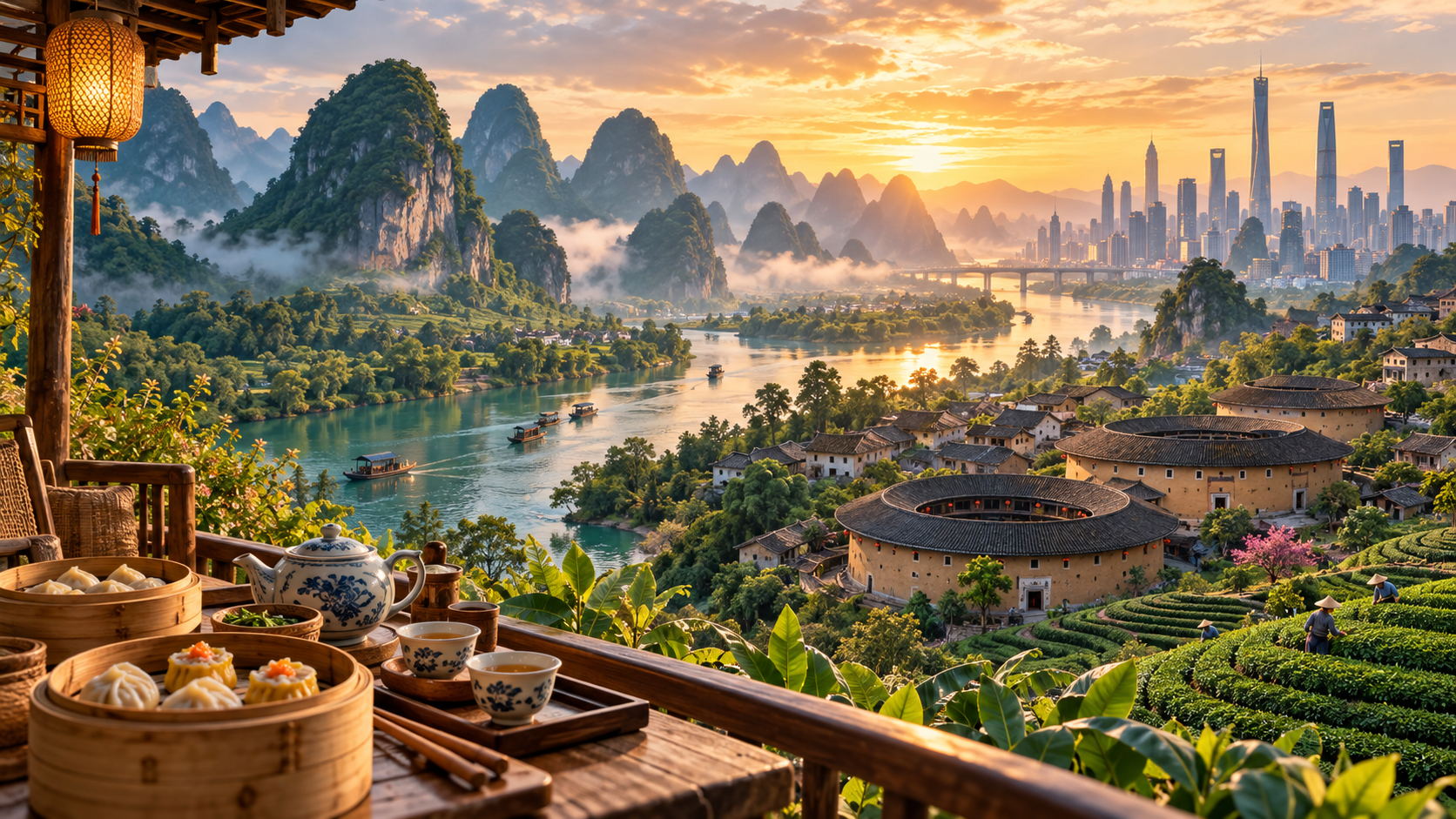
Say “southern China” and the picture changes depending on who you ask.
One person thinks of Guangzhou and dim sum. Someone else imagines the limestone peaks around Guilin. Another sees tropical beaches on Hainan, round earthen tulou in Fujian, or misty mountains in Yunnan.
All of those answers make sense.
Southern China is less a single destination than a huge collection of landscapes and cultures below the country’s colder northern heartland. Depending on how the term is used, it can include Guangdong, Guangxi, Fujian, Hainan and parts of Yunnan, Guizhou and neighboring areas.
The borders are fuzzy because “south China” can be geographic, cultural or simply conversational.
But one thing is clear: this is not Beijing with palm trees.
The climate changes. The food changes. Languages and dialects change. Mountains become greener. Rice fields appear more often. Coastlines stretch toward the South China Sea. Cities such as Shenzhen look almost futuristic, while villages only a few hours away can contain architecture shaped by centuries of local tradition.
For American travelers, that contrast is probably the best reason to go.
So what actually counts as southern China?
There is no single tourism map that everyone agrees on.
In everyday travel discussions, southern China often centers on Guangdong, Guangxi, Fujian and Hainan, while Yunnan and Guizhou are frequently included in a broader southwestern or southern travel picture.
That distinction matters less once you’re actually planning a trip.
You are not taking a geography exam.
You are trying to figure out whether you want megacities, tropical islands, karst mountains, historic villages or some combination that does not require changing hotels every twelve hours.
| Region | Best Known For | Travel Feel |
|---|---|---|
| Guangdong | Guangzhou, Shenzhen, Cantonese food | Urban, fast, food-focused |
| Guangxi | Guilin, Yangshuo, karst landscapes | Scenic, rural, outdoorsy |
| Fujian | Tulou, tea, coastal cities | Historic, mountainous, coastal |
| Hainan | Tropical beaches and resorts | Warm, relaxed, island-focused |
| Yunnan | Mountains, ethnic diversity, old towns | Varied, highland, culturally rich |
| Guizhou | Karst, villages, waterfalls | Green, mountainous, less obvious |
The biggest planning mistake is treating all these places as if they were neighboring suburbs.
China is huge.
Even “the south” is huge.
Guangzhou is a good first look at the region
Guangzhou makes a strong starting point because it gives you several versions of southern China at once.
It is one of the country’s major cities, a historic trading center and the heartland of Cantonese food culture.
Modern Guangzhou looks big and confident.
The skyline around Zhujiang New Town includes glass towers, major cultural buildings and the instantly recognizable Canton Tower across the Pearl River.
Then you move into older parts of the city and the mood changes.
Arcaded streets, temples, markets, traditional neighborhoods and tea houses remind you that Guangzhou did not appear when the skyscrapers did.
The city has been connected to international trade for centuries.
That history also helps explain why Cantonese culture traveled so widely overseas.
For many Americans, foods they first encountered in a Chinatown restaurant have roots here.
Dim sum is not a tourist performance
Yes, you should eat dim sum.
But think of it less as a list of dumplings and more as a social meal.
The Cantonese tradition of yum cha revolves around tea, conversation and multiple small dishes arriving over time.
Shrimp dumplings, siu mai, rice noodle rolls, steamed buns, turnip cakes and chicken feet may all appear, depending on the restaurant.
The pace is important.
People talk. Tea gets refilled. More food arrives.
It is not supposed to feel like speed-running breakfast.
And this is where travel gets funny. You may recognize half the food from American Chinese restaurants, yet the meal itself feels completely different.
Shenzhen shows the opposite side of southern China
Take Guangzhou’s long history and flip the emphasis.
That gets you closer to Shenzhen.
Shenzhen is strongly associated with technology, manufacturing, design and extremely rapid urban growth. Its skyline is packed with towers, metro stations are enormous, and parts of the city feel built at a scale that makes downtowns elsewhere look oddly small.
But Shenzhen is not just glass and electronics.
It has parks, coastal areas, mountains, older urban villages and neighborhoods where everyday life feels much more casual than the central business districts suggest.
The useful thing about visiting Guangzhou and Shenzhen on the same trip is comparison.
They are close geographically.
They are not the same city wearing different clothes.
Then Guilin changes the entire mood
Now leave the Pearl River Delta and move toward Guangxi.
The skyline disappears.
Limestone towers rise out of fields and rivers instead.
Guilin is famous for karst scenery – steep limestone formations shaped over enormous spans of geological time.
The broader South China Karst is recognized by UNESCO for spectacular landscapes including tower karst around Guilin.
The Li River is the classic view.
You have probably seen it even if you did not know the name: narrow river, green peaks, hazy distance, small boats and reflections on calm water.
It looks like someone painted a traditional Chinese landscape and then forgot to make it fictional.
Yangshuo is where people usually slow down
Guilin is the larger city and transportation hub.
Yangshuo is the place many travelers remember emotionally.
The town sits among karst peaks and gives easier access to countryside scenery, cycling routes, river trips and villages.
It is tourism-heavy in parts, especially around the central streets.
Walk or cycle away from the busiest center and the scenery changes quickly.
Rice fields, narrow roads, rivers and vertical limestone hills create a landscape that feels almost exaggerated.
For a first visit, do not treat Yangshuo as one quick photo stop after a river cruise.
Stay overnight if you can.
Karst landscapes are more than pretty mountains
Southern China’s limestone scenery exists across a huge area.
Guilin gets the fame, but Guangxi, Guizhou, Yunnan and other provinces contain different forms of karst.
Some landscapes produce isolated towers. Others contain caves, sinkholes, natural bridges or densely packed limestone hills.
This matters because travelers often imagine southern China as humid cities and rice fields.
Then suddenly the ground starts behaving like architecture.
It is one of the region’s defining visual features.
Fujian’s tulou look like buildings from another planet
Drive into the mountainous countryside of Fujian and you can encounter large circular or rectangular earthen structures known as tulou.
They are among southern China’s most distinctive architectural landmarks.
The Fujian Tulou recognized by UNESCO were built between the 13th and 20th centuries and developed as communal residences with strong defensive qualities.
From outside, some look almost fortress-like.
Inside, living spaces are organized around large open courtyards.
The fascinating part is that these were not palaces built for one wealthy family.
They were designed around communal life.
And they sit in fertile mountain valleys where the relationship between landscape and architecture is part of the experience.
Fujian also has a serious tea story
If you drink oolong tea, southern China starts getting familiar fast.
Fujian is associated with several major Chinese tea traditions, including famous oolongs and other varieties.
Mountain climate, soil and processing methods all influence the final tea.
But tea here is not only agriculture.
It is also hospitality, routine and social ritual.
You may encounter small cups, multiple short infusions and a style of serving that asks you to pay attention to aroma and change across steepings.
It can feel almost overly serious if your normal tea experience involves dropping a bag into a mug.
Give it ten minutes.
You may understand why people care.
Xiamen offers a softer coastal stop
Not every southern Chinese city feels like Guangzhou or Shenzhen.
Xiamen, in Fujian, has a more relaxed coastal identity.
The city is known for waterfront scenery, subtropical greenery and Gulangyu, a small island associated with historic architecture and pedestrian streets.
The pace can feel easier than the megacities farther west.
Seafood matters here, naturally.
So do Fujian flavors that may taste lighter or more broth-focused than the Sichuan food many Americans think of when they imagine “Chinese food.”
Yunnan is basically several trips hiding inside one province
Yunnan is where the phrase “southern China” starts becoming almost too broad to be useful.
The province stretches from subtropical zones near Southeast Asia to high mountain landscapes close to the Tibetan Plateau.
That means climate, architecture, food and culture can change dramatically within one province.
Kunming is the major gateway.
Dali brings lake and mountain scenery.
Lijiang is known for its historic old town and Naxi cultural heritage.
Farther northwest, the terrain becomes truly dramatic.
The Three Parallel Rivers of Yunnan Protected Areas contain sections of the upper Yangtze, Mekong and Salween running roughly parallel through deep gorges and high mountains.
UNESCO describes the area as a major center of biodiversity.
This is not tropical southern China anymore.
Some peaks rise above 19,000 feet.
Dali works because the landscape does half the job
Dali sits between Cangshan mountains and Erhai Lake.
That location alone makes it appealing.
The old town gets plenty of visitors, but the wider area matters just as much.
Villages, farmland, mountain paths and the lakeshore give you room to move beyond the central tourist streets.
Dali is also associated with Bai culture, adding another reminder that China is not culturally uniform.
Southern and southwestern China contain many recognized ethnic groups with their own languages, clothing traditions, foodways and festivals.
Lijiang is beautiful and busy – both can be true
Lijiang’s old town is one of China’s best-known historic urban destinations.
Stone streets, canals, wooden buildings and mountain views make it immediately attractive.
It is also heavily visited.
Those facts do not cancel each other out.
Go early in the morning. Walk away from the busiest commercial lanes. Learn something about Naxi history instead of treating every old building as generic “ancient China.”
The more context you have, the more interesting Lijiang becomes.
Hainan feels like another country entirely
Fly south to Hainan and winter suddenly starts losing its authority.
The island province has a tropical climate and has become China’s best-known beach destination.
Sanya, on the southern coast, is the resort name most international travelers encounter.
Beaches, palm trees, warm water and large hotels dominate the tourism image.
But Hainan is not only resorts.
There are tropical forests, smaller towns, local seafood traditions and inland landscapes that receive far less international attention.
Still, if your southern China trip has been all mountains, trains and city streets, two beach days can feel very reasonable.
What should you eat across southern China?
This is where any attempt to summarize the region gets slightly ridiculous.
The food changes too much.
Still, a first-time traveler can look for a few broad experiences:
- eat dim sum and Cantonese roast meats in Guangdong;
- try rice noodles and regional specialties in Guangxi;
- drink Fujian tea and look for local seafood along the coast;
- try mushroom dishes and regional minority cuisines in Yunnan;
- eat fresh seafood and tropical fruit in Hainan;
- try local breakfast food instead of eating every morning at an international hotel buffet.
The final point sounds small.
It changes trips.
Breakfast is often where everyday food culture is easiest to see.
Rice matters, but not always the way you expect
Northern Chinese food is strongly associated with wheat products such as noodles, dumplings and buns.
Southern food traditions rely more heavily on rice, though the north-south divide is not absolute.
Rice appears as plain steamed rice, rice noodles, rice rolls, congee and many regional snacks.
In Guangxi and Yunnan especially, rice noodles become an entire category of meals rather than one standardized dish.
The broth changes. Toppings change. Heat changes.
Ordering “rice noodles” tells you about as much as ordering “sandwich” in the United States.
Southern China’s climate needs actual planning
The south is generally warmer and more humid than northern China.
That does not mean every destination has the same weather.
Guangzhou can feel hot and sticky while highland Yunnan is cool enough for a jacket.
Hainan can be tropical while mountainous northern Yunnan deals with much colder conditions.
Rainy seasons and typhoon risk also matter in coastal areas.
So please do not search “southern China weather,” see one temperature and pack accordingly.
| Area | General Climate | Packing Reality |
|---|---|---|
| Guangdong | Humid subtropical | Light clothing, rain protection, layers in cooler months |
| Guangxi | Warm and humid | Rain gear and breathable clothing |
| Fujian | Humid coastal/subtropical | Light layers and weather flexibility |
| Hainan | Tropical | Sun protection and lightweight clothing |
| Yunnan highlands | Elevation-dependent | Layers, sun protection and warmer clothing |
Elevation may matter more than latitude.
That is especially true in Yunnan.
When is the best time to visit?
There is no single perfect season for the entire south.
For Guangdong and Guangxi, fall can be appealing because temperatures often become more comfortable after the hottest, wettest part of the year.
Spring is green but can be rainy.
Summer is hot, humid and wet in many lowland areas.
Yunnan’s highlands can work well in several seasons, depending on elevation and exactly where you’re going.
Hainan attracts many travelers during cooler months when northern China is cold.
The useful strategy is simple: plan by destination, not by the phrase “southern China.”
High-speed rail changes the trip completely
China’s rail network makes distances that look intimidating on a map much easier to handle.
Guangzhou and Shenzhen are closely connected by rail. Guilin is accessible by high-speed train from major southern hubs. Xiamen connects efficiently with other coastal cities.
Flights still make sense for longer jumps, especially toward Hainan or distant parts of Yunnan.
But there is a catch.
Major Chinese railway stations can be enormous.
A “train at 10:00” does not mean strolling onto a platform at 9:57.
- arrive with enough time for station navigation and security;
- keep passport and ticket information accessible;
- check the exact station because many cities have several major terminals;
- avoid scheduling tight connections until you understand the system;
- pack so you can move your own luggage through large stations.
That last point deserves more love.
A giant suitcase feels much heavier when your platform is somewhere beyond what appears to be a small airport.
Do you need to speak Chinese?
Not fluently.
But outside highly international business districts, English is not something you should assume.
Translation apps are extremely useful.
Keep destination names available in Chinese characters. Hotel addresses should be saved in a form a driver or local staff member can easily read.
Learning basic Mandarin phrases helps too.
In southern China, you may also hear Cantonese, Hokkien-related varieties, Hakka, local dialects and minority languages.
Mandarin remains the common language for travel across regions.
Cashless life may surprise American visitors
Mobile payments are deeply embedded in everyday urban life in China.
Small stores, restaurants, transport systems and vendors often rely heavily on digital payments.
Foreign travelers increasingly have ways to connect international cards with major payment systems, but setup rules can change.
Do this before you’re standing at a noodle counter with fifteen people behind you.
Keep a backup payment option as well.
Travel gets easier when payment logistics are boring.
What places belong on a first southern China trip?
If this is your first visit, variety works better than quantity.
A balanced trip might include one major city, one major landscape region and one slower cultural or coastal stop.
- Choose Guangzhou for food, history and a major-city introduction.
- Add Guilin and Yangshuo for classic karst scenery.
- Choose Fujian if traditional architecture and tea interest you.
- Choose Yunnan if mountains, regional cultures and longer overland travel appeal more.
- Add Hainan if you genuinely want tropical beach time.
Trying to combine all five in ten days would technically produce many photos.
It might not produce much vacation.
What Americans often get wrong about southern China
The first mistake is assuming it is all tropical.
Hainan is tropical. Guangzhou is subtropical. High-altitude Yunnan can be cold.
The second mistake is assuming Cantonese culture represents the entire south.
Cantonese culture is hugely important, especially in Guangdong and in the history of Chinese communities overseas.
But Fujian, Guangxi, Yunnan, Hainan and Guizhou have very different cultural stories.
The third mistake is thinking southern Chinese food means everything is mild.
Some Cantonese cooking emphasizes clean flavors and careful preparation, yes. Other southern and southwestern cuisines can be sour, spicy, smoky, herb-heavy or intensely aromatic.
The fourth mistake is imagining the whole region as modern megacities.
Leave Guangzhou or Shenzhen and the scenery can change faster than expected.
Slow travel works especially well here
Southern China rewards contrast.
But contrast only works if you stay somewhere long enough to notice it.
Spend three days in Guangzhou rather than fourteen hours.
Stay in Yangshuo overnight instead of rushing back immediately after a boat ride.
Drink tea in Fujian without checking the time every four minutes.
Let Dali or Lijiang become more than a photo stop.
The region is not a collection of backgrounds.
It is lived-in.
FAQ About Southern China
What is considered southern China?
The term is flexible, but Guangdong, Guangxi, Fujian and Hainan are commonly associated with southern China. Broader travel definitions may also include Yunnan, Guizhou and nearby southern or southwestern areas.
What is southern China famous for?
The region is known for Cantonese food, major cities such as Guangzhou and Shenzhen, Guilin’s karst scenery, Fujian tulou, tropical Hainan, Yunnan’s mountains and a wide range of regional cultures.
What is the best city to visit in southern China?
Guangzhou is one of the easiest first choices because it combines history, famous food traditions, modern architecture and strong transportation links. Shenzhen, Xiamen and Kunming offer very different experiences.
Is Guilin worth visiting?
Yes, especially for travelers interested in scenery. The Guilin and Yangshuo region is known for dramatic limestone karst peaks, rivers and countryside landscapes that are very different from China’s major cities.
What food is southern China known for?
It depends on the region. Cantonese dim sum and roast meats are famous in Guangdong, while Fujian has strong tea and seafood traditions, Guangxi is known for rice noodles, and Yunnan has mushrooms and highly varied regional cuisines.
When is the best time to visit southern China?
Fall is comfortable in many lowland southern destinations, while spring can be green but wetter. Hainan is popular in cooler months, and Yunnan’s ideal season depends strongly on elevation and route.
How many days do you need for southern China?
Ten to fourteen days works for two or three major areas. Three weeks is much better if you want to combine Guangdong, Guangxi, Fujian or Yunnan without spending half the trip moving between hotels.
Southern China Makes More Sense Once You Stop Treating It as One Place
The phrase southern China sounds neat.
The actual region is not.
That is exactly why it is interesting.
Guangzhou might begin with tea and steamed dumplings in the morning and end beneath a glowing skyscraper beside the Pearl River.
A few hours away, Guangxi can replace the skyline with limestone mountains rising out of fields.
Fujian puts entire communities inside huge earthen buildings that look almost impossible until you’re standing in the courtyard.
Yunnan keeps climbing until southern China suddenly contains deep gorges, alpine terrain and snow-covered peaks.
Then Hainan takes the opposite direction and gives you palms, warm water and tropical air.
There is no one southern Chinese food.
No one southern landscape.
No one language or city type.
And that is the useful thing to remember when planning.
Do not build a trip around the idea that you need to “see southern China.”
Pick the version that sounds interesting.
Maybe that is a food-first week in Guangdong.
Maybe it is Guilin and rural Guangxi.
Maybe it is tea and tulou in Fujian.
Maybe it is a slower route through Yunnan.
Or maybe you combine two very different places and let the contrast do the work.
Just leave room.
Room for a long breakfast.
Room for a train ride through green countryside.
Room for tea served in cups far smaller than you expected.
Room for a mountain view that was not on your list.
Southern China gets better when it stops being a region on a map and starts becoming a series of places that do not quite match each other.
That’s the point.



Leave a Reply